
Odessa Criminal History Checks
Odessa has no combined village criminal-record portal. The event can produce records at the Sheriff's Office, county jail, shared Village Court, county-level court, and state repository. Start with the document or result sought, then contact the office that made it.
- Identify the responding agency from the ticket, incident number, or other paperwork. The published village pages do not list an Odessa Police Department.
- Ask Sheriff Records for a Sheriff incident or arrest report, using the date, place, report type, and incident number when known.
- Contact Odessa Village Court for a local docket or disposition. State “Odessa Village Court” because the office also supports Catharine Town Court.
- Use Schuyler County corrections for booking or current custody and the county court clerk if a felony prosecution moved beyond local court.
- For one's own fingerprint-linked record, use DCJS Personal Record Review; use OCA court channels for public statewide court history.
This order prevents a common mix-up. The Village Office cannot supply a Sheriff report, and a booking record cannot prove the result of a court case. Each source describes a distinct point in the process.
Odessa Shared Court Records
Odessa's most important local feature is its shared court service with the Town of Catharine. The court operates at 5182 Park Road, Odessa, NY 14869. Its phone is (607) 594-2273, fax is (607) 594-2274, and clerk email is KMAllen@nycourts.gov. The same office supports two court identities, so the exact caption matters.
The official Odessa Village Court page documents this shared-service arrangement and its current schedule.
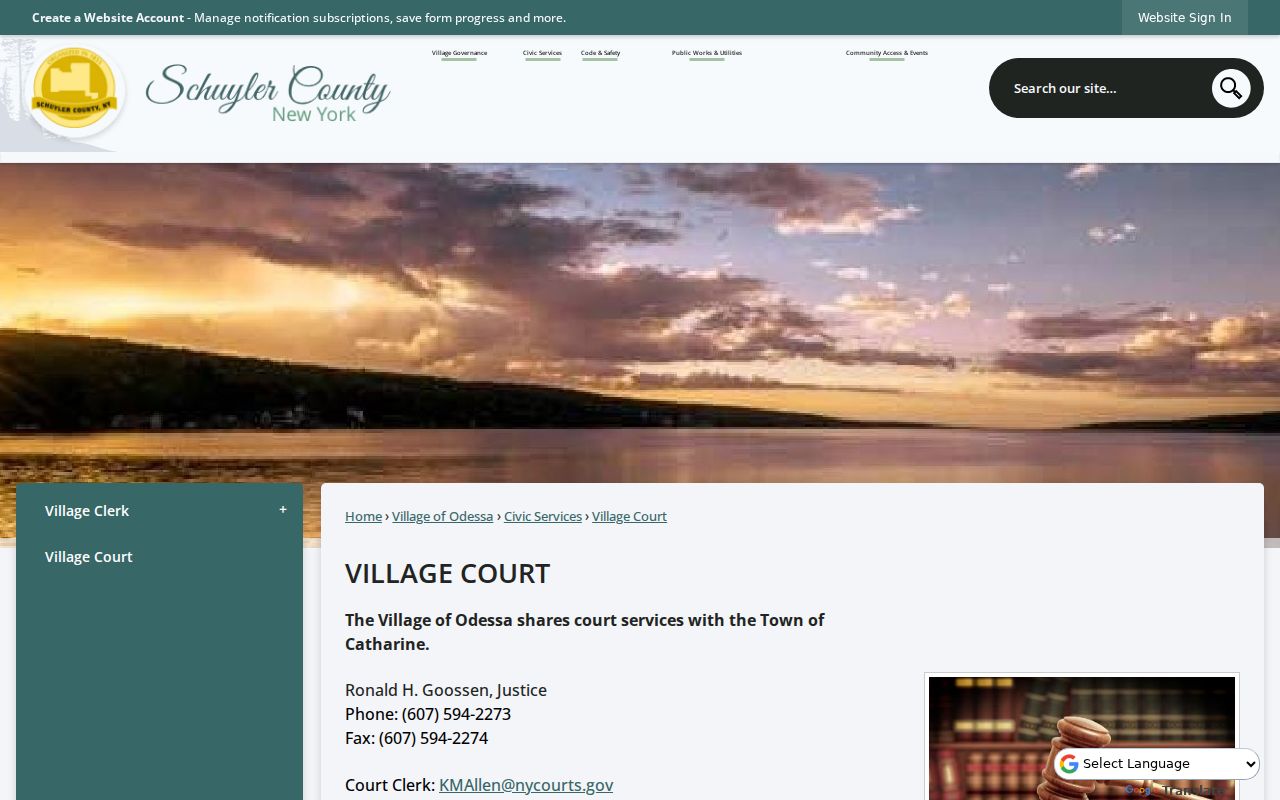
The image shows the official court channel, not a case-search portal. No public name or docket-number lookup is published there. Call, email, or visit the clerk with the court caption, case or ticket number, party name, approximate date, and record requested.
Records at the Odessa Police Department
Odessa's official pages do not publish a village police department, police records counter, arrest blotter, or jail. The Village Office handles municipal administration at 1928 County Road 15, Odessa, NY 14869. Phone is (607) 594-2100, fax is (607) 594-4282, and posted hours are Monday through Thursday, 8:00 a.m. to 1:00 p.m.
The official Village of Odessa page supplies the complex view and contact block shown below.
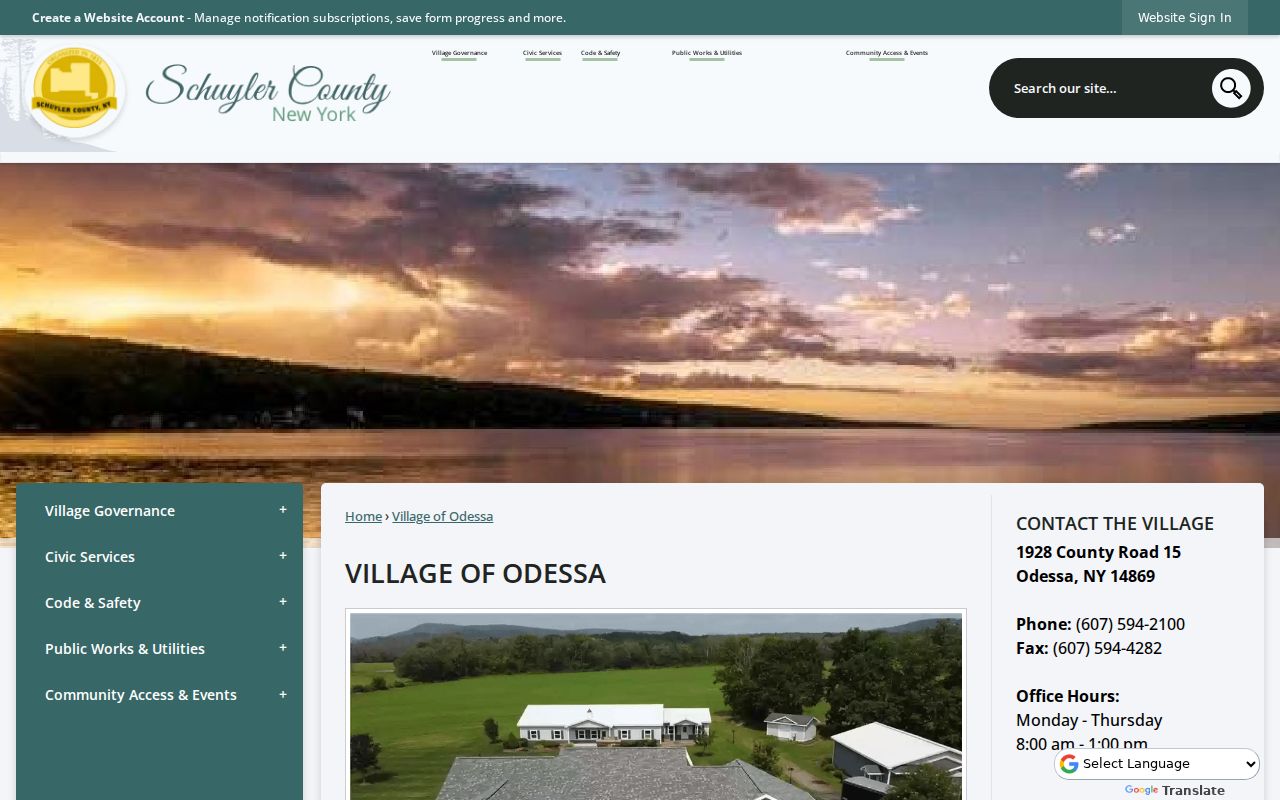
This office is the right start for village-held administrative records. It does not become the custodian of a Sheriff's incident file or the shared court docket. The county planning profile also lists clerk@nyvillageofodessa.com, but callers should confirm the current request method before sending records by email.
Odessa Police Records Use the Sheriff
With no published Odessa Police Department, the practical law-enforcement route is often the Schuyler County Sheriff. The Sheriff provides county patrol, criminal investigations, 911 dispatch, and corrections. Call (607) 535-8222 for nonemergency direction and 911 for an emergency. Ask which agency responded if the paperwork is missing.
Schuyler County Sheriff Records
106 Tenth Street, Unit 2
Watkins Glen, NY 14891
(607) 535-8227
Mon-Fri 8:00-4:30
Sheriff Records accepts sheriff-specific requests by counter, mail, or email at SheriffRecords@co.schuyler.ny.us. Copies are 25 cents per page. A sheriff records check requires photo ID or a notarized requisition, and mailed records-check copies require a self-addressed stamped envelope. Those rules should not be projected onto Odessa village or court records.
New York State Police can also act in the area. A trooper's report remains with State Police, not the Sheriff or Village Office. The incident number and agency name are the best routing clues.
Booking and Arrest Records in Odessa
No village holding facility is published for Odessa. A person arrested by a Sheriff's unit can be booked through Schuyler County corrections in Watkins Glen. The jail creates intake and custody data, while the arresting agency keeps the event report. The court later creates its own file at arraignment. Those records can update at different times.
Schuyler County has no official public jail roster. For present custody, call the Sheriff's main line at (607) 535-8222. For a public historical booking record, use Sheriff Records at (607) 535-8227. A useful request can specify booking date or number, arresting agency, intake charges, custody or release status, and bond data where releasable.
An intake charge is an allegation. It may be reduced, dismissed, or replaced in court. Use the correct court disposition to establish the result. The Schuyler County Arrest Search provides the broader county channel without turning arrest material into proof of guilt.
Odessa Monday Court Record Timing
The current village court page posts Odessa Village Court for 9:00 a.m. Mondays except holidays, with the District Attorney present on the second Monday except holidays. Other official directories have shown 10:00 a.m. and older clerk details. That difference reflects schedule drift, not two sessions a requester can safely assume.
Call (607) 594-2273 before visiting. Ask whether the requested file is available at the counter and whether the planned Monday is a village session, a Catharine Town Court session, or a date with the prosecutor. Court schedules can change for holidays and administrative reasons.
The District Attorney's presence does not make that office the custodian of the docket. Prosecutors handle the case, while the court clerk maintains the filed public record and disposition. Ask the clerk for the case file even when a village page links to District Attorney forms.
The Odessa Municipal Court File
Odessa Village Court hears local matters within a New York village court's jurisdiction, including traffic, village matters, misdemeanors, arraignments, and felony preliminary stages. Its shared arrangement with Catharine Town Court changes the office setup, not the identity of each docket. Always name Odessa Village Court when requesting the village file.
| Court Name | Odessa Village Court, sharing services with Catharine Town Court |
|---|---|
| Case Types Heard | Village matters, traffic, misdemeanors, arraignments, and felony preliminary proceedings within jurisdiction |
| Case Lookup Channel | Phone, email, or court counter; no public village online lookup is published |
| What the Docket Shows | Caption, case number, filed charges, appearances, status, disposition, and sentence where public |
| Copies & Fees | Confirm copy, certification, payment, and return-mail rules with the court clerk |
Odessa Court Captions Prevent Missed Records
A shared clerk can search more than one docket series, but the requester still needs the correct caption. “Catharine Town Court” and “Odessa Village Court” are not interchangeable labels. The village also sits at the boundary of the towns of Catharine and Montour, making the place name alone a weak court identifier.
Read the court line on a ticket or summons. If the paper is unavailable, give the event date, responding agency, place, and case type when calling. Ask the clerk to confirm which court received the accusatory instrument. A “no record” response from the wrong caption does not prove that no case exists.
If a felony complaint advanced beyond preliminary steps, follow it to Schuyler County Court at 105 Ninth Street in Watkins Glen. The Schuyler County Court Case Lookup explains the superior-court file and state search limits.
How Odessa Records Reach the County
An Odessa event may begin with a Sheriff's deputy or state trooper. The arresting agency keeps its report. Schuyler County corrections adds booking data if the person is lodged there. Odessa Village Court records local arraignment and preliminary proceedings, while a felony prosecution can move to the county-level court.
Record flow: Responding law-enforcement agency in Odessa › Schuyler County Courts › New York State Division of Criminal Justice Services
For reportable arrests, DCJS can use fingerprints to attach the arrest cycle and later reported disposition to an NYSID. Personal Record Review is limited to the subject or the subject's attorney. OCA's public CHRS product uses exact name and date of birth and is a court-history search, not a fingerprint rap sheet. Neither state product replaces the local report or docket.
Odessa Record Statistics Need Context
The 2020 Census counted 578 people in Odessa, ranking it third among Schuyler County's incorporated places. Odessa is a village. The county planning profile describes it as a gateway on Route 224 near the line between Catharine and Montour, with heavy summer travel toward Watkins Glen International and the Hector wine trail.
That corridor matters when reading law-enforcement totals. A small resident population does not capture seasonal drivers and visitors. Yet no official Odessa-only crime report was found. County Sheriff or DCJS agency totals cover a broader area and should not be relabeled as village counts.
For a person-specific question, broad statistics are the wrong tool. Use the Sheriff incident record, county booking file, and exact court docket. They document the event and result without turning agency-wide activity into an unsupported Odessa crime rate.
Odessa Notify Me Is Not Records
The official village site offers “Notify Me!” subscriptions for notices such as water breaks and changes to office hours. It is a municipal message service. It does not search arrests, warrants, booking data, court cases, or the sex offender registry.
This is more than a naming detail. A public notification button can look like a safety database even when it only delivers village operations news. Use the Sheriff's channels for a police or booking record and the shared court for a docket. State registry relocation notices come through a separate New York system.
Odessa publishes no police app or app-only arrest search. Do not treat a missing app as a dead end. The documented phone, email, counter, and records-request routes remain the correct official path.
Odessa Record Context From Catlin Mills
Odessa's official history traces a distinct village timeline. The land formed part of the Watkins-Flint purchase. A grist mill appeared in 1801, a sawmill in 1837, and the settlement was surveyed as Catlin Mills in 1839. The name changed to Odessa in 1845.
The timeline also records that the village became “dry” in 1877 and remained so until after repeal of Prohibition. That is a local governance milestone, not evidence about current crime. Historical municipal material belongs with village archives, while modern criminal files follow the Sheriff, court, and state channels described here.
Place history helps explain why modern service areas and captions can differ from a simple map label. Odessa spans town-boundary context and shares court operations with Catharine. Exact office and court names remain vital when searching records today.
What Odessa Criminal Records Mean
A Sheriff report states what law enforcement recorded. A booking file documents intake and custody. A court file shows filed charges, appearances, and the outcome. A DCJS record links fingerprint-supported arrest cycles with reported court results. These are related records, not copies of one master file.
- Arrest cycle
- A fingerprint-linked grouping that connects one arrest event with charges and later reported dispositions.
- Disposition
- The charge-level result, such as conviction, dismissal, or acquittal.
- Certificate of disposition
- The court-issued statement of the official outcome in one case.
- Sealing
- A legal limit on public access; it is not simply a search failure.
If two records differ, compare their dates and purpose. Police charges can change before filing, and a court update may take time to reach DCJS. Someone auditing their own record can compare a court certificate with an unsuppressed DCJS response and use the state challenge process if needed.
Odessa Record Access Rules
New York FOIL governs access to village administrative and executive-agency records held by the right custodian. It does not govern judicial case files. A requester asks the Odessa Village Court clerk for a reasonably described public docket under Judiciary Law §255. A Sheriff file goes to the Sheriff's records officer, not the Village Office.
Key Statutes:
Public Officers Law §87 sets agency access rules and permits specific privacy, safety, investigation, and confidentiality exemptions.
Judiciary Law §255 directs public court-file requests to the clerk that holds the judicial record.
Criminal Procedure Law §160.50 generally seals records after qualifying favorable terminations, subject to statutory exceptions.
Juvenile matters, sealed cases, active investigations, victim-sensitive details, and information posing a privacy or safety risk may be withheld or redacted. Request segregable public portions when part of a document is exempt. A blank result can reflect sealing, old reporting limits, timing, or the wrong shared-court caption rather than proof that no event occurred.