
Schuyler County Criminal History Checks
No single Schuyler County database contains every criminal record. Begin with the event or outcome you need. The Schuyler County/Supreme Court clerk is the direct source for felony dockets and certified dispositions. A town or village justice court keeps the local case when it handled the charge. The Sheriff's Records Division supplies sheriff-created incident, arrest, booking, jail, and warrant-related material that is public after review. New York's court tools add statewide reach, but they do not replace the underlying file.
Good identifiers save time. Use a docket, incident, or booking number when known. Otherwise, have the exact legal name, an approximate date, the arresting agency, and the court named on the paperwork. Date of birth can help an authorized clerk distinguish common names, but each office decides which identifiers it may accept or release.
- Identify whether the record began with the sheriff, another police agency, a local justice court, or Schuyler County Court.
- Call the custodian first and confirm that it holds the file, especially when a local case may have moved to County Court.
- Use WebCriminal for available appearance data or OCA CHRS when a statewide public court-name search is needed.
- Ask for the docket or disposition before ordering a large file, then specify public documents and certification needs.
- For your own fingerprint-confirmed statewide record, schedule DCJS Personal Record Review through IdentoGO.
Schuyler County Records Across Two Buildings
Schuyler County's records geography is unusually compact. Court, prosecution, county-clerk, and probation functions sit at 105 Ninth Street in Watkins Glen. Sheriff records, dispatch, jail intake, and corrections functions sit next door at 106 Tenth Street. The short distance does not merge the files. A police narrative remains with its originating agency, a booking record stays with the jail or sheriff, and the filed criminal case belongs to the court clerk.
This distinction prevents a common dead end. The County Clerk is a key county records counter, but the Unified Court System's County/Supreme Court clerk is the operative contact for a criminal docket or certified disposition. At the other building, Civil and Records are separate sheriff functions. Report requests belong with Records, not the Civil Division.
County/Supreme Court Clerk
105 Ninth Street, Unit 35
Watkins Glen, NY 14891
(607) 228-3350
Weekdays, 8:30 a.m. to 4:30 p.m.
Sheriff Records Division
106 Tenth Street, Unit 2
Watkins Glen, NY 14891
(607) 535-8227
Weekdays, 8:00 a.m. to 4:30 p.m.
Note: The courthouse's accessible entrance and accessible parking are at the rear, while public parking is on site or adjacent.
Official Background Checks in New York
The New York State Division of Criminal Justice Services is the official repository. Its Personal Record Review program lets a person obtain their own fingerprint-based rap sheet or a “no record” response. It is not a public name search for someone else. New York residents make an IdentoGO appointment and choose service code 15464Z for a suppressed response or 15465F for an unsuppressed response. The unsuppressed form is more useful for a self-audit because it includes sealed or suppressed material the subject may lawfully review.
The current DCJS fingerprint-processing charge is $17.50, and DCJS estimates three to four weeks after it receives the submission. The response arrives by mail. For a public statewide court-history search, the separate OCA Criminal History Record Search costs $95 for each exact name and date-of-birth combination. CHRS covers reported public pending cases and convictions, but it excludes sealed matters and has historical limits for town and village courts.
The DCJS Personal Record Review instructions show the official service codes, eligibility rules, and correction route.
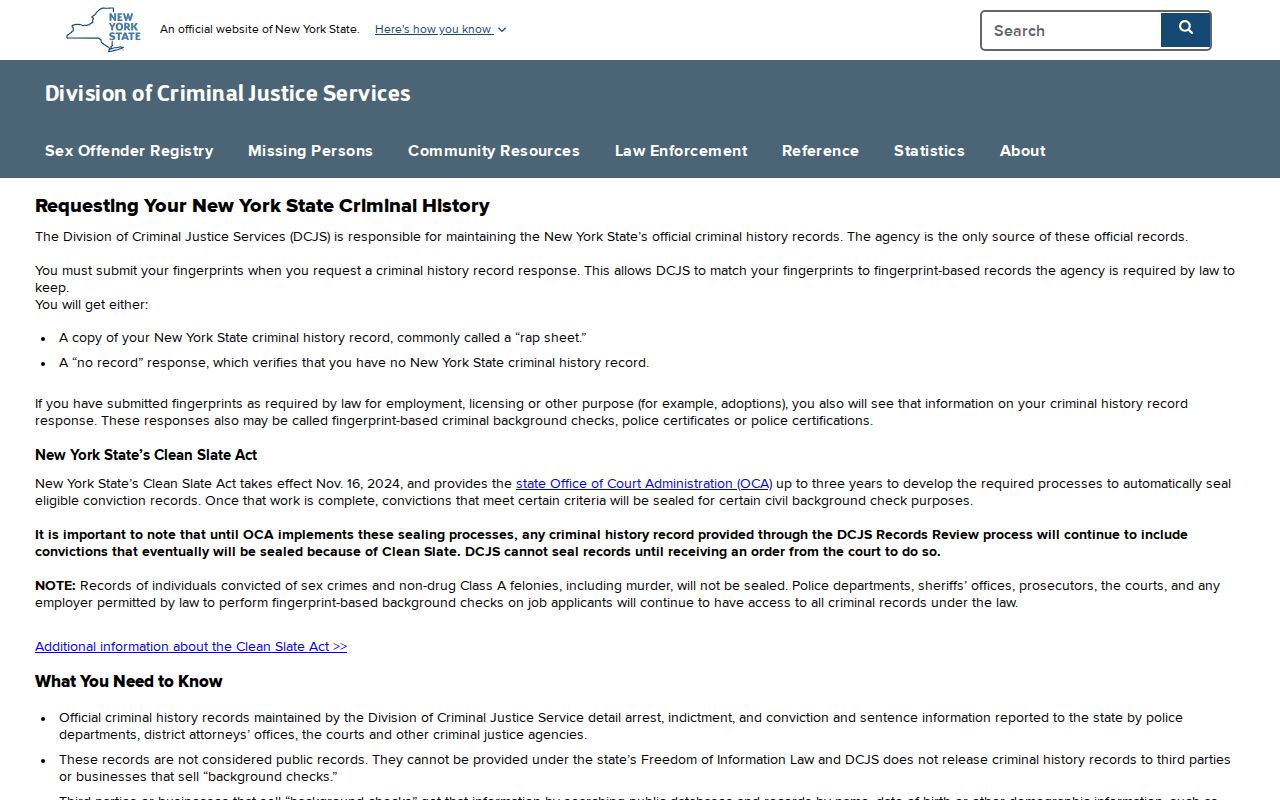
The captured state page reinforces the key boundary: fingerprints verify the subject's own New York record, while a name-based court search is a different product.
Schuyler County Sheriff Record Requests
The Sheriff's Records Division is the practical fallback when no public county search exists. Requests may be made in person, by mail, or by email at SheriffRecords@co.schuyler.ny.us. The county also provides an online FOIL request form. A sheriff records check requires photo identification or a notarized records requisition. Mailed requests for a records check or accident report need a self-addressed stamped envelope.
Describe the existing record with care. Include an incident number, date range, location, people involved, arresting agency, and the exact material sought. The county must respond to a FOIL request within five business days by granting or denying it, seeking clarification, or acknowledging it with an approximate decision date. An acknowledgment ordinarily points to a decision within 20 business days, though the county may explain why more time is needed.
| Access channel | Best use | Key requirement |
|---|---|---|
| Email or mail | Sheriff reports and record checks | Describe the event; add ID or notarization when required |
| Records counter | Help locating sheriff-held material | Visit during posted weekday hours |
| County online FOIL | Written county records request | Choose inspection or copies and give a detailed description |
| Court clerk | Docket, filed papers, certified disposition | Use the court route, not FOIL, for a judicial case file |
Kinds of Criminal Records
A Schuyler County arrest may produce several records that update at different times. The arresting agency creates the incident and arrest report. The jail creates intake and custody records. A justice court or County Court opens a docket once accusations are filed. Fingerprint-supported arrest information and later outcomes can reach DCJS. A record search is strongest when it compares the right parts of that chain.
Custody and supervision produce more files. The county jail tracks local detention. DOCCS maintains state prison and parole data. Schuyler County Probation holds supervision records, while the sentencing court's public disposition may show that probation was imposed. DCJS also runs the state sex offender registry, with local law enforcement handling registration and verification duties.
- Incident and arrest reports describe the reported event and law-enforcement action.
- Booking records document jail intake, custody, bond, and release status.
- Court files track filed charges, appearances, pleas, rulings, disposition, and sentence.
- DCJS rap sheets link fingerprint-supported arrest cycles to reported outcomes.
- Supervision records arise through county probation or DOCCS community supervision.
Schuyler County Jail and Booking Records
The Schuyler County Jail operates in the Public Safety Building and currently reports capacity for 30 people. No official public inmate roster was located. That absence makes the phone-and-records route important. Call the Sheriff's main line at (607) 535-8222 for present custody or release routing. Historical booking material should go to Records at (607) 535-8227 or through a focused FOIL request.
A booking entry can show arrival time, arresting agency, intake charges, custody or release status, bond information, and a booking photograph if releasable. It cannot prove guilt. The court sets release terms, bail, remand, and later appearances. When a person moves to state prison, use the DOCCS Incarcerated Lookup; county pretrial detainees will not ordinarily appear there.
Recent Schuyler arrests may pass through centralized arraignment, known as CAP arraignment. That means a person can be booked at the county jail before a felony case is visible in County Court. For the record trail, check the arresting agency first, then the jail, the arraigning justice court, and finally the county clerk if the matter advances.
Note: A booking charge records the allegation at intake and may differ from the charge that a prosecutor later files.
Schuyler County Criminal Records: What They Contain
A New York rap sheet is organized as a fingerprint-linked chronology, not a simple conviction list. The DCJS record can connect one arrest cycle to prosecutor and court reports. A local court file, by contrast, is organized around a docket. Booking material centers on custody. Read the label and custodian before drawing a conclusion from any field.
| Name & Identifiers | Names, aliases, date of birth, demographic details, NYSID, and an FBI number when applicable. |
|---|---|
| Arrest / Booking Data | Arrest date, agency, tracking identifiers, intake time, and charges alleged at that stage. |
| Charges & Statutes | Offense text, New York statute citation, classification, amendments, and count-level changes. |
| Disposition | Conviction, dismissal, acquittal, youthful-offender result, or another final outcome. |
| Sentence | Jail or prison, probation, conditional discharge, restitution, fines, and supervision. |
| Custody / Supervision | County jail history, DOCCS identifiers, parole, or post-release supervision where reported. |
Reporting gaps do occur. An arrest might not have required fingerprints, an older justice court may have incomplete reporting, or a disposition may not yet have reached DCJS. Sealing can also remove a matter from public results. Comparing a court certificate of disposition with an unsuppressed personal DCJS response is the sound route when your own record looks wrong.
Schuyler County Warrant Record Channels
Schuyler County publishes no official active-warrant database or public most-wanted list. The complete path starts with the issuing court shown on missed-appearance papers or another notice. A town or village justice court maintains its own bench-warrant case record. County/Supreme Court handles the relevant county-level felony file. The Sheriff's Office receives information needed to execute warrants, but an active investigation, sealed warrant, sealed indictment, or juvenile matter may not be public.
For an urgent surrender or safety question, call sheriff dispatch at (607) 535-8222 rather than relying on email. For public warrant-related documents, contact Records. Ask the court whether an appearance can be scheduled, where surrender is directed, and when a returned or vacated warrant will be updated. An absent web result is not proof that no warrant exists.
- Arrest warrant
- A court order authorizing arrest on a criminal accusation.
- Bench warrant
- An order often issued after failure to appear or noncompliance in an existing case.
- Search warrant
- Authority to search a place or item; it may remain sealed during an investigation.
- Detainer
- A hold lodged by another authority, not necessarily a New York criminal warrant.
New York Public Access Laws
New York Freedom of Information Law applies to executive agencies, including sheriff and police records, but it does not govern judicial case files. Court records are requested from the clerk under Judiciary Law §255. Neither route overrides a sealing order or confidentiality rule. An agency may redact or withhold material tied to privacy, active investigations, confidential sources, nonroutine law-enforcement methods, or safety.
Key New York authorities:
Public Officers Law §87 sets FOIL access, exemptions, and the ordinary 25-cent copy limit for pages up to 9 by 14 inches.
Executive Law §837 authorizes DCJS criminal-history collection and repository functions.
Judiciary Law §255 guidance directs public court-file requests to the clerk rather than FOIL.
CPL §160.50 generally seals records after a qualifying favorable termination.
CPL §160.57 creates Clean Slate automatic sealing for eligible convictions.
A precise request helps the custodian separate public material from exempt parts. Ask for reasonably segregable portions when a report contains restricted details. DCJS rap sheets remain outside county FOIL because they are not general public records.
Schuyler County Probation Record Forms
Schuyler County Probation is county-run under state standards. It supervises probation sentences and supports local alternatives such as Pretrial Services and the Community Service Program. Pretrial monitoring is not a conviction or probation sentence. There is no public probation name lookup. A court disposition can establish that probation was imposed, while treatment notes, addresses, and supervision details remain subject to privacy and access limits.
The department publishes an unusually detailed set of client and court materials. The Schuyler County probation form library includes general, DWI, domestic-violence, sex-offender, conditional-discharge, pretrial, electronic-monitoring, restitution, and violation forms.
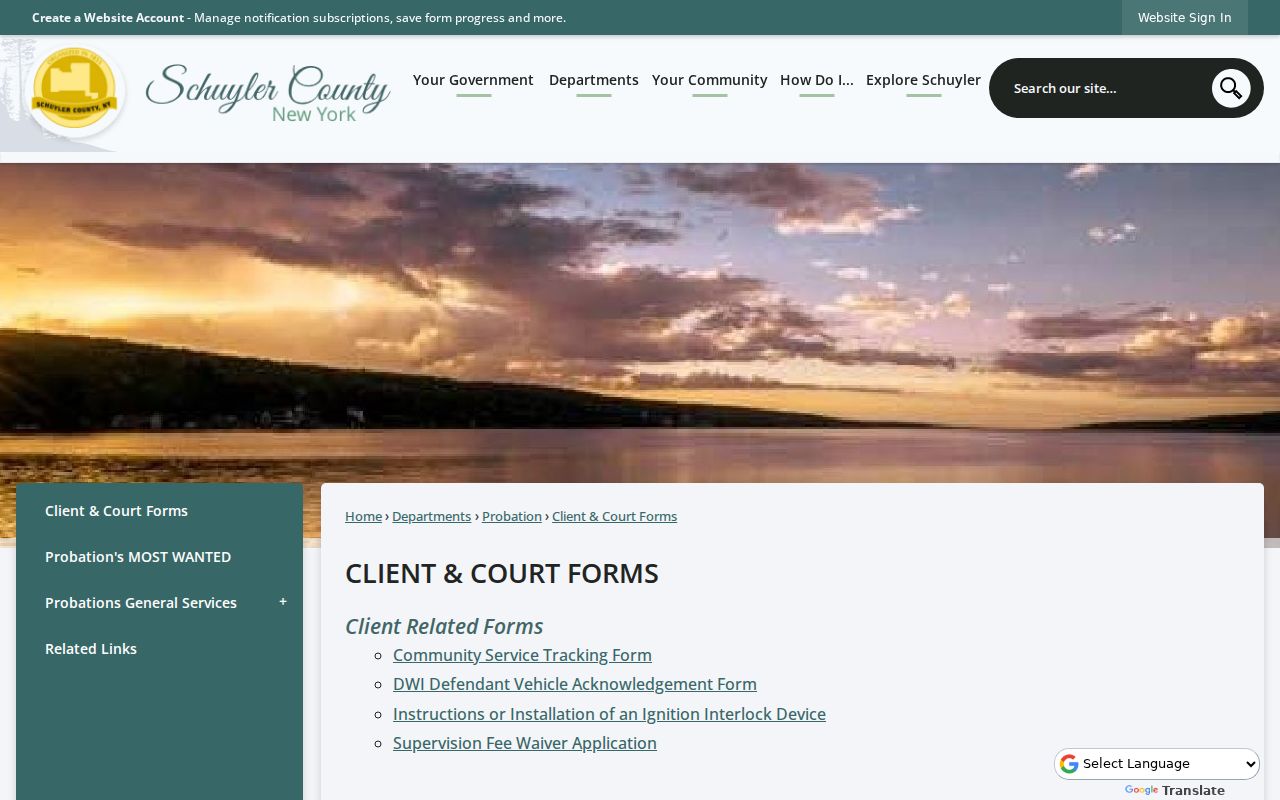
The form page shows why a public sentence entry and the department's working supervision file are different record layers.
Schuyler County Parole Record Lookup
State parole and post-release supervision belong to DOCCS, not county probation. Schuyler County falls within the Elmira Area Office. The public Parolee Lookup accepts NYSID, DIN, a full or last name, or name plus birth year. It excludes youthful offenders and warns about lag and accuracy, so no result is not proof that supervision never occurred.
The DOCCS Parolee Lookup displays the available identifier and name-search fields.
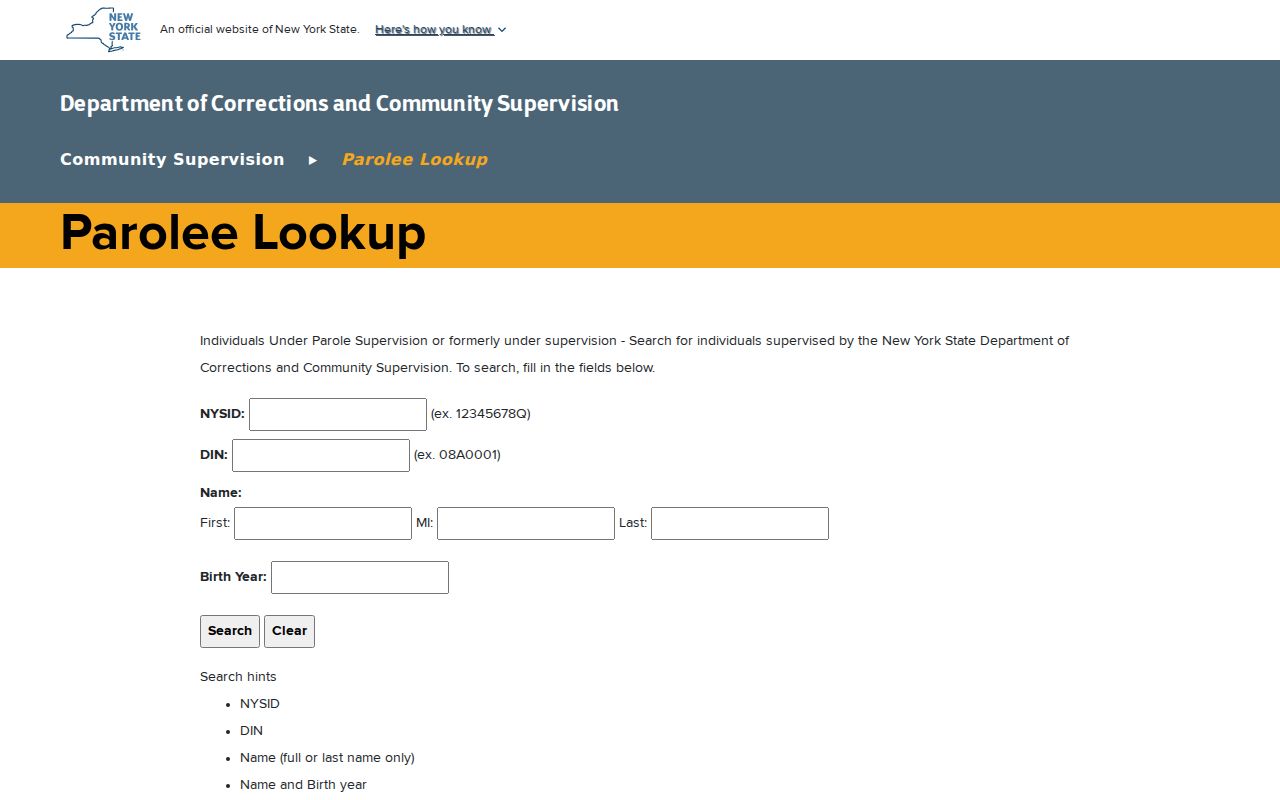
The official lookup is the right statewide layer for parole status, while Schuyler County Probation remains the local contact for an authorized probation inquiry.
Restricted, Sealed & Expunged Records
Record sealing is New York's main remedy. Favorable outcomes are generally sealed under CPL 160.50. CPL 160.59 lets a person ask the sentencing court to seal up to two eligible convictions, with no more than one felony, after the statutory ten-year period and subject to exclusions. Class A felonies, violent felonies, homicide offenses, sex offenses, and other listed convictions are not eligible under that process. The applicant obtains certificates of disposition, serves the district attorney, and files the application and proof of service with the sentencing court.
Clean Slate under CPL 160.57 took effect in 2024, but the court system has until November 16, 2027 to complete automatic processing. Waiting periods are generally at least three years for an eligible misdemeanor and eight years for an eligible felony, measured under the statute's rules. Pending charges and ongoing supervision can delay sealing. A record that should qualify may still appear during implementation.
New York does not usually destroy adult criminal records. Certain former cannabis convictions receive broader treatment and are vacated, dismissed, sealed, and expunged. Juvenile, youthful-offender, victim-sensitive, and personally identifying information also follows separate restrictions. For your own suspected mismatch, obtain the court disposition and use DCJS review and challenge procedures.
Schuyler County Criminal Record Corrections
A court file, CHRS result, and DCJS rap sheet can disagree without any office acting as the sole source for all three. Exact-name spelling can defeat a CHRS match. A local disposition may be late reaching DCJS. Sealing may remove an entry from public results while it remains visible to the subject in an unsuppressed response. Start by identifying the incorrect field and the agency that created it.
For your own state history, request the unsuppressed DCJS response. Compare each disputed arrest cycle with a certificate of disposition from the court that decided the case. Follow the correction instructions in the DCJS packet and supply the court proof it requests. If a sealing order was granted but not reflected, the Unified Court System offers an official Request for Seal Verification process.
Do not treat a clean online result as a formal all-record clearance. Public searches omit sealed matters and may have historical or reporting limits. Likewise, an unresolved arrest entry does not establish that the case remained pending. The final court record supplies the authoritative outcome.
Schuyler County Criminal Records During Arraignment
Schuyler County uses centralized arraignment coverage for off-hours cases. This local flow can split a recent event across agencies before every database catches up. The arresting officer creates the first papers, the county jail records intake, and the arraigning court sets release conditions and a next date. If felony proceedings continue, a later indictment can move the file to County Court.
Local record flow: Police action → Sheriff booking → CAP or local arraignment → prosecutor charging decision → County Court or justice-court case → disposition reporting to DCJS.
The small county's prosecution workload has also produced added part-time staffing and continued weekend and holiday on-call coverage. Those measures support early case processing, but they do not create a new public portal. A searcher should still use the arresting agency for the report, the jail for custody, and the correct court clerk for the filed case.
Note: The clerk may have the newest judicial event before a statewide name search or fingerprint repository displays the update.
City-by-City Criminal Records in Schuyler County
Schuyler County's three largest incorporated places are villages, not cities. Their record routes differ. Watkins Glen operates a village police department and village court. Montour Falls publishes no village police records desk, so the responding agency and Sheriff are central. Odessa also uses the Sheriff channel and shares court services with the Town of Catharine. Each village page separates local administration, police or sheriff records, booking, and court files.
Watkins Glen Record Check
Population 1,838 · Village police records, county booking, and a separate Village Court counter.
Montour Falls Record Check
Population 1,635 · Sheriff/responding-agency route and a Village Court separate from the clerk.
Odessa Record Check
Population 578 · Sheriff records and shared court services with Catharine Town Court.